| Feature | What it changes | Planning use |
|---|---|---|
| Truck design | Curfboard credits its truck design for stronger carving and pumping. The claim is the manufacturer’s, with no measured values. | Compare trucks by feel before buying. Treat the claim as a reason to test, not a guarantee. |
| Truck choice and wheelbase | Every surfskate truck changes the wheelbase measurement, and set-back axle trucks narrow it. | Check the wheelbase with the truck fitted, not the deck alone. |
| Deck flex | Torsional flex is the board twisting in the middle as it responds to the rider’s movements. | Choose a cambered, flexy deck if long pumping runs matter most. |
| Complete board price | Curfboard lists complete surfskates from $349 to $489 USD. | Use this as a brand-specific budget marker for a complete board. |
Figures and descriptions come from Curfboard’s complete surfskate listing and the Surfskate.love custom build guide.
A surf skate board is a skateboard built to carve and pump like surfing on pavement, and its truck design does most of that work. Choose by truck feel and deck flex first, then by price.
New riders should settle basic balance and stance first, and skateboard lessons calgary is the place to start. Surf-style carving builds on those basics.
What a surf skate board changes for the rider
Curfboard describes surfskates as “the closest thing to surfing on the road” and states that they are not normal skateboards or longboards. Carver, another maker, says its boards replicate the fluid dynamics of surfing on land, using patented truck systems for deep, carving turns and self-propelled movement. In practice, the rider’s body motion steers the board and can also build speed, so a flowing ride matters more than pushing off the ground.
How it differs from a regular skateboard
The main difference sits in the trucks. Because every surfskate truck changes the wheelbase measurement, two boards with similar decks can ride quite differently. Wheelbase here is the distance between the inner bolt holes on the deck.
Retail listings also show a price gap. These examples come from one shop’s skateboard collection:
- Regular complete: the Arbor Foundation Pocket 27″ complete skateboard is listed at $179.99 USD.
- Surf skate complete: the Carver 32.25″ Electric Acid Surf Skate C7 complete is listed at $265.00 USD.
- Carver complete skateboard: the Carver CI Noserider C7 Raw 37″ complete skateboard is listed at $285.00 USD.
In that shop’s listings, the Carver complete boards cost more than the regular complete. Expect to pay more for a surf-style setup than for a basic board. Compare specific listings rather than assuming a price from the board type.
Choosing a surf skate board
Most buying decisions come down to the trucks, then the deck. The Surfskate.love builder lists the criteria it uses to pick a surfskate truck, and they work as a checklist for any complete board too.
- Feel: tight, sharp and snappy trucks suit riders who want precise response. Loose, smooth and flowy trucks suit riders who want a relaxed, rolling turn.
- Wheelbase offset: a truck shifts the effective wheelbase, so the offset changes how the board turns under your feet.
- Rebound: how the board springs back out of a turn affects how easily you can link the next one.
- Rail-to-rail lean: a truck that leans further lets the rider drive the board through deeper carves.
- Forward momentum: some trucks hold speed through a turn better than others, which matters for pumping.
- Weight and customization: heavier trucks add to the board’s weight, and some can be tuned more than others.
The same builder starts most custom builds with the Carver CX, Waterborne Surf Adapter or YOW Meraki. Those make sensible reference points when you compare complete boards, since a complete board with a known truck is easier to judge.
Matching deck flex to how you ride
The builder describes a cambered, flexy deck as fantastic for long-distance pumping. That is an opinion rather than a measurement, but it points to a clear choice. If you want to cover distance by pumping on smooth paths, look for a flexier deck. If you want a board that feels firmer underfoot, a stiffer deck is the safer starting point.
How surf skate trucks and deck flex work
Surf skate trucks are the component that separates these boards from ordinary skateboards. Curfboard attributes its carving and pumping gains to its unique truck design, and Carver builds its boards around patented truck systems. A set-back axle truck narrows the wheelbase compared with the same deck on a conventional truck. That is why reading a wheelbase figure without knowing the truck can mislead.
Deck flex is the second part of the mechanism. Torsional flex means the board twists in the middle as it responds to the rider’s movements. A deck that twists a little gives the board a springy feel as you shift weight, while the trucks control how far each turn leans.
Pumping and carving on a surf skate board
Carving is the sweeping, leaned turn that surf skate trucks are designed to deliver. Pumping is how a rider turns repeated carves into speed without pushing off the ground, which is the self-propelled movement Carver describes. Learn carving first, because pumping is just carves linked into a rhythm.
How to pump
- Start on flat, smooth, quiet pavement with your knees bent and your feet apart in a relaxed stance.
- Lean toward your toes to start a shallow carve in one direction. Keep your shoulders facing along the board.
- Press down through your legs as the carve deepens, then let your legs rise as the board comes out of the turn.
- Shift your hips toward the opposite edge and begin the next carve the other way.
- Repeat the down-and-up rhythm in time with the board’s rebound, and keep the turns small until the motion feels continuous.
Drive the motion from your legs and hips and use your arms only for balance. A stiff, stabbing push or an arms-only wiggle breaks the flow. A flexier deck and a truck with good rebound make that rhythm easier to find, which is why the truck and deck choices above matter.
Using a surf skate board on Calgary paths
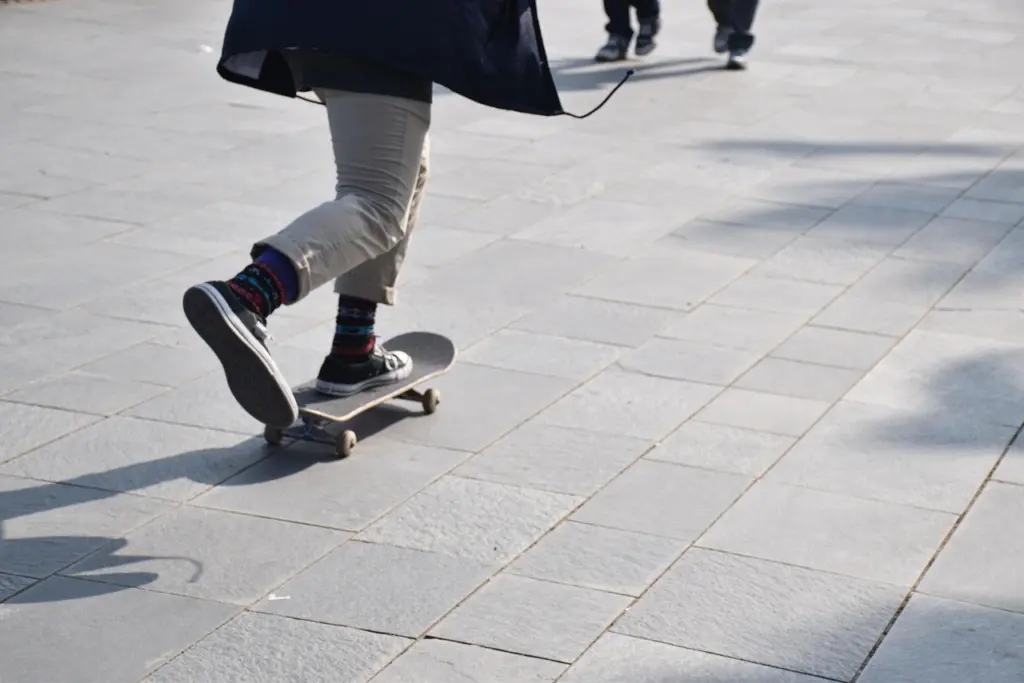
A surf skate board gives riders a road-based way to practise balance, carving and pumping without a skatepark. In Calgary, that fits dry-season sessions on smooth paved paths, with quiet stretches best for learning. Wait for dry pavement and check path rules and local conditions before riding.
Riders who also want trick basics on a standard board can start with 5 Easy Skateboard Tricks You Can Learn Fast: A Beginner’s 2026 Guide – Calgaryskateboarding. For wheel choices, see Best Skateboard Wheels in 2026: Pick The Right Set For Speed, Grip, And Pop – Calgaryskateboarding.
Frequently asked questions
What should younger or lighter riders look for?
Status Skate Shop says younger surfskaters tend to benefit from shorter boards with relatively loose trucks. Its kids surfskate collection lists complete boards from $263.95 to $269.00 USD.
Can I build a surf skate board from separate parts?
Yes. The Surfskate.love guide lists trucks sold separately, including the Carver C7, Carver CX, Grasp and YOW Meraki, and it explains how to match trucks, wheelbase and deck flex in a custom build.
Where does the Carver brand come from?
A retailer page states that Carver was founded in Venice, California, in the mid-1990s.