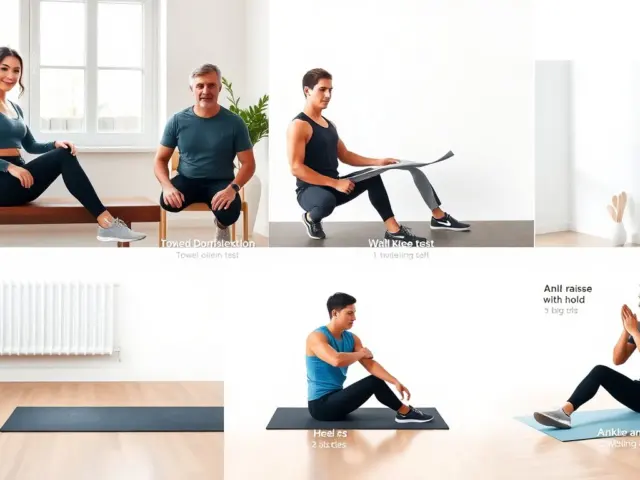
A skater who keeps rolling an ankle on landings may ask whether balance board exercises are worth the floor time. Yes, as a supplement: they train ankle control and the core, and a review links them to lower sprain risk.
Balance work is one part of skate fitness, and the answer to is skateboarding good exercise sets the wider context. The sections below separate what balance boards do from what they are often assumed to do, then turn that into a progression you can run beside your normal skatepark sessions.
What balance board exercises train
Balance boards, which include rocker boards and wobble boards, are a fitness tool used for balance, posture and rehab, according to Healthline. The main skill they train is proprioception, the perception of your body position and movements in three-dimensional space. Experts believe ankle proprioception plays a critical role in balancing. Wobble board training can also train the muscles, ligaments and tendons to work together to create stability at the ankle.
The trunk is involved too. Aeromats explains that wobble board exercises primarily target the core muscles, including the abdominals and lower back. Healthline adds stronger lower leg muscles, especially the peroneals. For a skater, ankle control is the quality most likely to carry over to a moving deck, which is why the board works best as an off-board routine rather than a replacement for time on the deck.
| Common misunderstanding | What is supported | Planning use |
|---|---|---|
| A balance board is a gym gimmick | Physical therapists often use balance boards in the rehabilitation of lower leg injuries, specifically ankle sprains. | Treat it as a serious ankle-control tool and give it a planned place in your week. |
| It only works the ankles | Wobble board exercises primarily target the core, including the abdominals and lower back, and strengthen lower leg muscles, especially the peroneals. | Judge a session by trunk control and ankle control together, not just how long you stay up. |
| More wobble is always better | An unstable surface can increase the risk of falling, particularly for beginners or people with injuries. | Start on a forgiving board with a wall or rail within reach. |
The table draws on Healthline’s balance board overview and Aeromats’ wobble board guide.

Understanding what the board trains makes its most-discussed benefit easier to judge, and that benefit is injury prevention.
Ankle sprain prevention and rehabilitation
Balance boards have a clinical role as well as a fitness one. Physical therapists often use them in the rehabilitation of lower leg injuries, and ankle sprains are the specific example. Healthline reports one recent review of 7 randomized controlled trials with a total of 3,726 participants, which concluded that proprioceptive training using a balance or wobble board can reduce the risk of a first-time or recurrent ankle sprain.

The wording matters. The finding is that risk can be reduced, not that a trained ankle cannot roll. It suits skaters who have already sprained an ankle and want a structured way to rebuild control, and skaters who simply want to lower their odds. If the ankle is currently painful or swollen, rehabilitation belongs under a physiotherapist’s direction rather than in a self-led plan.
Choosing a board as a beginner
The best board for a beginner is the one that is forgiving while you learn and has a weight limit that covers you. Because an unstable surface raises fall risk, a cushioned or stable board makes early sessions calmer. Whirlyboard’s exercise guide notes that each exercise has entry-level and advanced variations, so you can make a drill harder without buying new equipment.
Fluidstance’s board guide gives a concrete range of specifications to compare:
- The Original: described as an excellent choice for users up to 350 pounds, the highest limit of the boards listed.
- Plane Cloud: a cushioned foam top that offers a comfortable, anti-fatigue surface for users up to 250 pounds, made with recycled materials. The softer surface suits a cautious start.
- Level Balance Board: sturdy support for users up to 300 pounds and aimed at intermediate to advanced users, so it is a later purchase rather than a first board.
These are manufacturer figures for one brand, useful as a template for what to check on any board: a stated weight limit and a clear target skill level. Weight limit is the user’s weight, not a measure of how stable the board feels.
Training frequency and progression
Aeromats says that incorporating wobble board exercises 2–3 times a week is a good start. That sits alongside a 2011 study of 23 older adults reported by Healthline, in which participants trained on a wobble board twice a week for 9 weeks. The trial was in older adults, so treat it as support for a modest weekly dose rather than a skater-specific schedule. Aeromats suggests starting with 30-second to 1-minute intervals of standing and increasing them as balance improves.
The phases below give that dose a shape. They are ordered by difficulty, not tied to calendar dates, so move on only when the earlier phase feels steady.
| Phase | Board work | Dose | Planning use |
|---|---|---|---|
| Foundation | Two-footed standing with a wall or rail in reach | 30-second to 1-minute intervals | Move on when you can finish an interval without grabbing support. |
| Control | Hold each position of a basic sequence | 30 seconds per position | Aim for quiet, steady holds before adding any movement. |
| Strength | Mini squats on the board | 10-15 reps | Add only after the holds feel controlled, so the board stays predictable. |
| Single-leg | Single-leg stand on the board | Build up gradually from your earlier interval lengths | Improves balance and strengthens the ankle and leg muscles. |
The dose figures come from Healthline and Aeromats.
Setting up single-leg work
When you reach the single-leg phase, face the board’s long axis so it rocks front to back. Swifty Scooters advises this rather than risking an ankle injury by going side to side.
Linking the plan to skatepark progress
Use the board to prepare for the skatepark, not to stand in for it. A short session before you skate gives the ankles and trunk a focused warm-up, and the skatepark is where you find out whether the control carries over. Once single-leg stands are steady, the lateral work in Skater Jumps: Build Explosive Lateral Power, Balance, And Speed (Step‑By‑Step Guide 2026) – Calgaryskateboarding is a natural next step.
Safety limits on an unstable surface
The board’s main risk is the one it is built around. Healthline notes that an unstable surface can increase your risk of falling, especially for beginners or people with injuries. Keep early sessions short, stay close to something you can grab, and treat each phase of the plan as complete only when it no longer needs that support.
Because falls are the main hazard, pair ankle work with attention to the joints that take the impact. Our guide to Wrist Mobility Exercises: Simple Routines To Reduce Pain, Improve Strength, and Boost Performance (2026 Guide) – Calgaryskateboarding covers the upper-body side of that routine.
Frequently asked questions
| Question | Answer |
|---|---|
| Do balance board exercises help skateboarding? | They support it. Healthline reports that experts consider ankle proprioception critical to balancing, and the board trains it alongside the core. They add to skatepark practice rather than replace it. |
| When should I ask a physiotherapist or trainer for help? | If you have ankle, hip or knee issues, Healthline suggests working with a physical therapist or certified personal trainer before starting. |
| Is a balance board a workout by itself? | It adds some effort but should not be your only exercise. In a study reported by Healthline, 30 adults used the board in 30-minute blocks, and energy expenditure was 14.2% higher than when sitting. That comparison is against sitting, not against other exercise. |